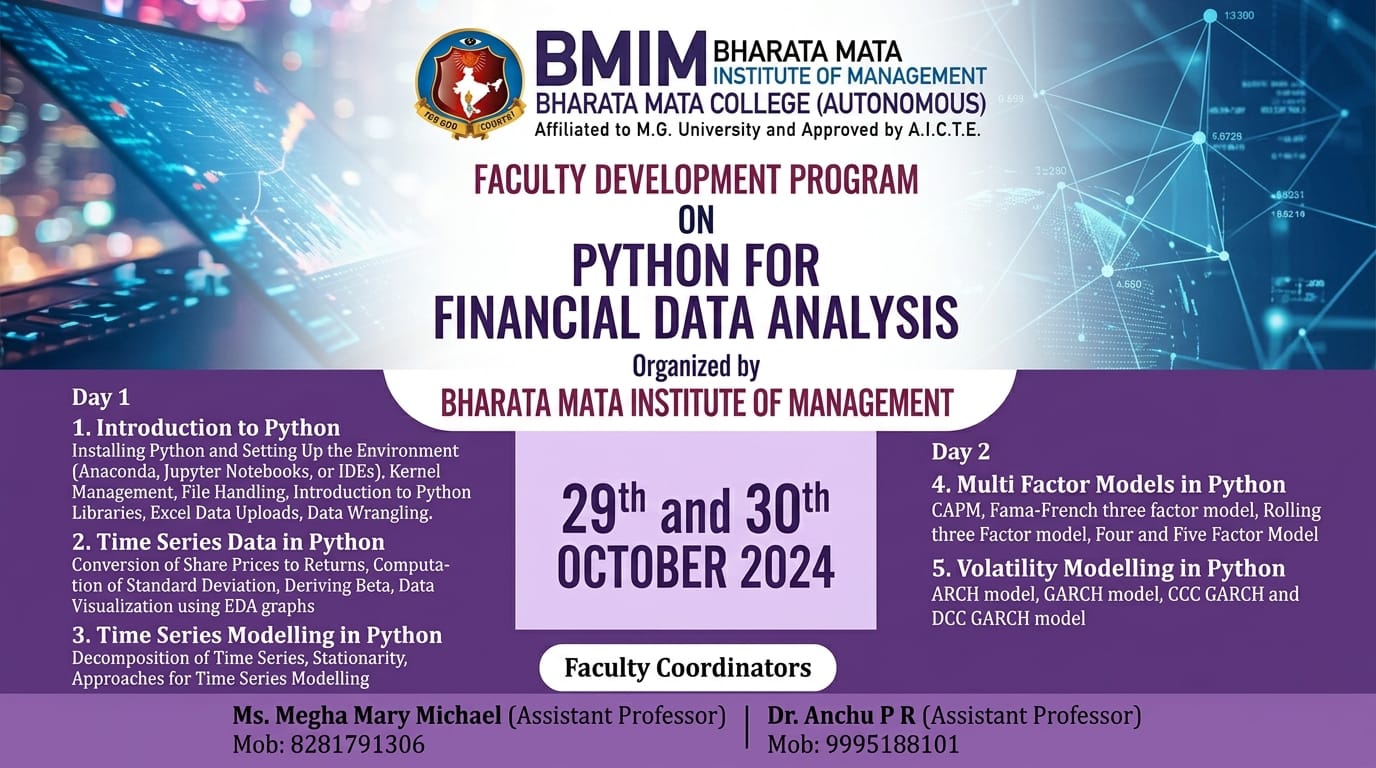
Faculty Development Program on Python for Financial Data Analysis at Bharata Mata Institute of Management
Empowering Academicians and Researchers with Modern Financial Data Analytics Bharata Mata Institute of Management (BMIM), affiliated with M.G. University and approved by AICTE, successfully organized a specialized two-day Faculty Development Program (FDP) on Python for Financial Data Analysis on October 29th and 30th, 2024. Designed to bridge the gap between foundational programming and advanced financial econometrics, the intensive workshop equipped participants with practical tools to handle complex financial datasets, build predictive models, and elevate research publication standards using secondary data sources. Key Highlights & Curriculum Covered The structured two-day program guided participants from beginner-level environment setups to advanced, non-amateur financial modeling applications. Day 1: Fundamentals, Time Series Data, and Time Series Modeling Introduction to Python Setup & Data Wrangling: Participants gained practical experience installing Python, managing environments (Anaconda, Jupyter Notebooks, IDEs), handling kernel configurations, reading Excel/CSV data files, and using core Python data libraries. Time Series Data Analysis: Session hands-on exercises included calculating share price returns, computing standard deviations, deriving financial Betas, and performing Exploratory Data Analysis (EDA) visualization. Time Series Modeling: Participants learned fundamental techniques for time series decomposition, testing for stationarity, and evaluating key time series modeling frameworks. Day 2: Multi-Factor & Volatility Econometric Models Multi-Factor Models in Python: The second day transitioned into advanced financial econometrics. Participants built models including the Capital Asset Pricing Model (CAPM), Fama-French Three-Factor Model, Rolling Three-Factor Model, as well as Four- and Five-Factor models using Python. Volatility Modeling: The program concluded with an in-depth exploration of financial market risk and volatility using ARCH, GARCH, CCC-GARCH, and DCC-GARCH modeling techniques.
Learning programs work best when they combine clear ideas, thoughtful structure, and regular feedback. Continue exploring new concepts that help your learners build confidence and apply skills in real situations.